… because I know people who can no longer work with epoxy resin because they developed a contact allergy.
Resin Art · Book
Safe Resin Art
For DIYers and professionals who work with epoxy resin
My why
Glossy. Fascinating. And yet risky.
Epoxy resin is taking over social media. Countless videos present working with resin as a simple DIY project, like baking or crafting: dump resin and hardener together, stir in colorful pigments, pour it into the mold, and let it cure. Voilà, a glossy work of art. But that impression is deceptive.
What’s missing from these viral clips? The respirator. The gloves. The warning about the hazards.
And that’s exactly where my mission begins …

Why did I write this book?
… because I see every day in my work how crucial it is to handle chemicals correctly, and how quickly a lack of knowledge turns into a risk.
… because I scroll through my Instagram and TikTok feeds and see content creators working with epoxy resin in kitchens, children’s rooms, or living rooms. No mask. No gloves. No idea what they’re actually holding in their hands. Not out of carelessness, but because they lack the expertise they need.
My superpower
My superpower? I break complex things down into simple ones. I find structure in chaos. I turn expert knowledge into practical knowledge.
As an industrial engineer, I can quickly get to grips with complex issues, recognize connections and interactions, and work methodically and systematically. As a certified trainer (AEVO qualification from the German Chamber of Industry and Commerce), I can explain difficult content simply and know how to pass on knowledge clearly. And as a Resin Artist? I’m one of you. Same struggles! I know the sticky fingers, the failed projects, and the addiction to the perfect pour. This unique mix of expertise, teaching skills, and creative practice makes this book special. My goal is to give you exactly the knowledge you need: clearly explained, practical, and without jargon.
What to expect
This book gives you insights usually reserved for experts. Here, knowledge from production and the lab comes together with my artistic practice. I don’t know the creative world only from the outside; I’m part of the Resin Art scene myself. I know how fulfilling this art can be and how important it is to take care of yourself while you do it.
This book is my invitation to you: shape your creativity consciously. With respect for the material. With care for yourself.
Safe Resin Art isn’t about fear. It’s about knowledge.
This book isn’t meant to scare you. It’s meant to inform you. Not to take away the fun of art, quite the opposite: you should be able to create in a healthy, safe way and with all your heart.
The reason I wrote it is simple: I know the risks, and I know how many people work with epoxy resin without the knowledge they need. In doing so, they expose themselves and often other people to hazards that would be easy to avoid with the right knowledge. This book shows you how to shape your creative path as a Resin Artist mindfully and responsibly, without fear but with solid knowledge.Because if you understand what you’re doing, you can decide freely and for yourself.And that’s exactly what I wish for you: freedom through knowledge.
Who is this book for?
This book is for you if you:
- Want to start Resin Art but work consciously and safely from the very beginning.
- Have been pouring for a while but feel there’s more to it: more protection, more knowledge, and more responsibility.
- Want to pass on your knowledge: to followers, students, customers, workshop participants.
- Love the material and respect it at the same time.
I believe art may shine, but not if it makes you sick. Resin can transform, but only if we truly understand it. And that’s exactly why we need more education, more commitment, and more responsibility in the Resin Art community.


Individual voices become a movement
This book isn’t just my project. It’s a joint effort. I deliberately invited more than 25 artists and woodworkers from the scene to take part. Among them are internationally known creators with a large reach, but also experts with deep knowledge who are less visible online and all the more valuable for what they know. In exclusive interviews, they all share their work routines, their safety measures, and their personal tips, straight from practice.
- about 1 million followers
- TikTok
- more than 400,000 followers
With a combined reach of about 1 million followers on Instagram and more than 400,000 followers on TikTok (as of May 2025), we’re taking a stand for safe Resin Art.
Figures as stated in the book at publication.
I’m grateful for every single interview, for the trust placed in me, and for the solidarity of this creative community.
Because real change doesn’t start alone; it starts together.
Want to make Resin Art?
Then do it. With dedication. With joy. But please do it safely.
And that’s exactly where I’ll be by your side. Step by step.
With love,
Natalie

Look inside
Real spreads from the English edition. Turn the page with the arrows, by swiping, with the keyboard, or by clicking the page.
-
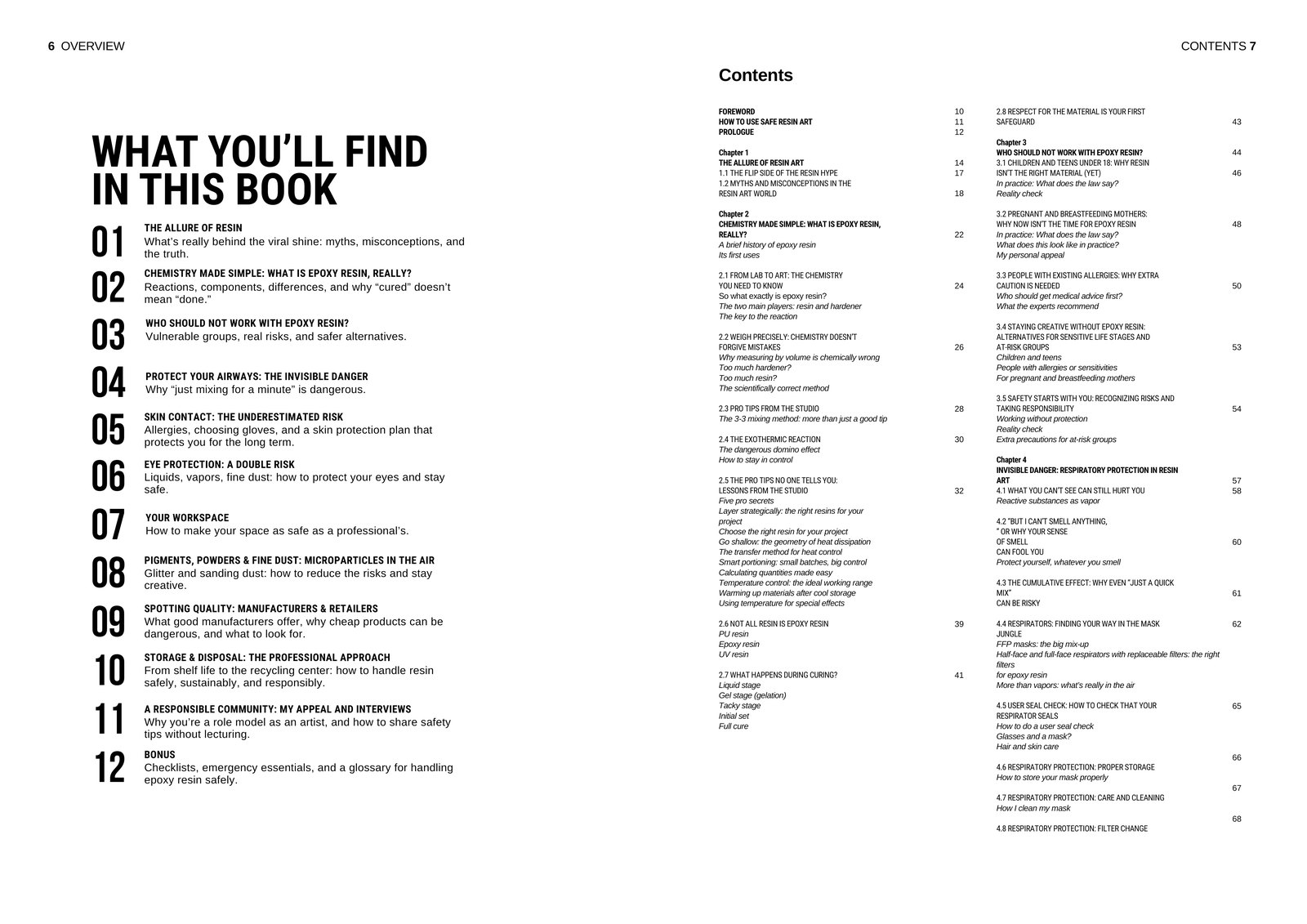
Overview and table of contents, pages 6 to 7 -

Chapter opener, Chemistry Made Simple, pages 22 to 23 -

Chapter opener, Who Should Not Work with Epoxy Resin, pages 44 to 45 -

Photo spread, resin works in lavender, pages 20 to 21 -

Interview, Roger Jungo, pages 132 to 133 -
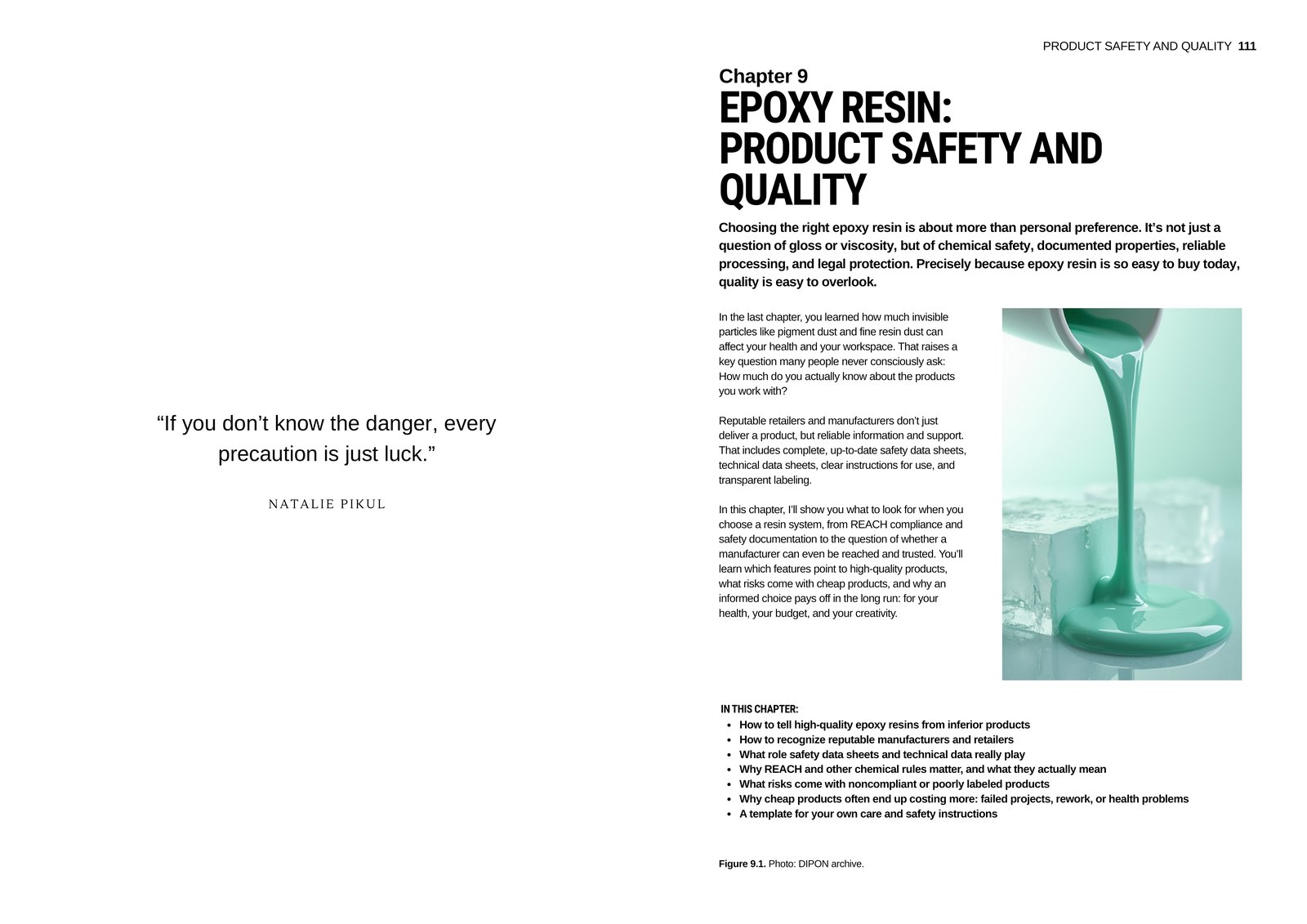
Chapter opener, Product Safety and Quality, pages 110 to 111


Tip: Click a page or “Zoom” to read it up close. Use the arrows to turn the pages.
Formats
Get the book
Choose your format and your favorite store.
Kindle e-book
For Kindle devices and the free Kindle app

Kindle stores worldwide: US UK Canada Australia Germany France Spain Italy Netherlands Japan Brazil Mexico India
PDF + EPUB
For iPad, tablets, computers, and e-readers

- PDF via GumroadFull-color PDF, the book exactly as printed
- EPUB via GumroadFixed-layout EPUB for Apple Books and other e-readers
One purchase on Gumroad includes both files, PDF and EPUB.
Paperback edition

Paperback coming soon
Coming soon
The e-book is on its way to more stores and libraries: Google Play Books, Apple Books, Kobo, Scribd, and libraries through OverDrive (Libby) and hoopla. The paperback will follow on Amazon and at online bookstores. The links will appear here as soon as each store goes live.
Safe Resin Art in real life


Inside the book
- How epoxy resin works, and why measuring by volume is chemically wrong
- Who should not work with epoxy resin, and why
- Respiratory protection that actually makes sense, and how to choose it
- Skin, gloves, and what to do if resin gets on your skin
- Eye protection and first aid
- Pigments, fine dust, sanding, and polishing without harming yourself
- Ventilation, storage, disposal, and setting up your workspace
- Insights and tips from more than 25 Resin Artists and woodworkers
Includes German and EU safety rules with US and UK equivalents noted throughout.
Written by Natalie Pikul. The English translation was created with the help of AI and reviewed by the author.
Also in German

The German edition is available as an e-book from Amazon Kindle and other stores, and in print from DIPON.
Resin Art series, Book 1 of 3
The Resin Art series
Resin Art is a three-part series for everyone who wants to create with epoxy resin: safely, confidently, and with real understanding of the material. Book 1, Safe Resin Art, lays the foundation.
The artists in this book
More than 25 Resin Artists from the international community share their experience in this book.
-

-

-

-

-

-

-

-

-

-

-

-

-

-

-

-

-

-

-

-
-

-
-

-

-

-

-



Free download: the four safety checklists
The printable checklists from the book, free for everyone: before you pour, while you work, after you pour, and the special safety checklist.
Download the safety checklists (PDF, English)
All free tools in one place: Free Tools
FAQ
Questions about epoxy resin and the book
The questions everyone asks when they work with epoxy resin, answered straight from Safe Resin Art.
Understanding epoxy resin
6 questionsWhat is epoxy resin, in simple terms?
Epoxy resin is a plastic made from two liquid parts, the resin (Part A) and the hardener (Part B), which react chemically and harden once they’re mixed. In that reaction, the resin’s epoxy groups bond with the hardener’s amines to form a three-dimensional network. The result is a solid plastic called a thermoset. The process can’t be reversed: cured epoxy resin can’t be melted or dissolved again.
Source: Safe Resin Art, chapter 2, pages 24 to 25.
How long does epoxy resin take to dry?
Strictly speaking, epoxy resin doesn’t dry; it cures through a chemical reaction. That reaction releases heat, and depending on the system, it can give off fumes, so you need protection even when your piece only seems to be “drying.” How long it takes depends on the resin: roughly 12 to 24 hours for top coat resin, 24 to 48 hours for standard casting resin, 48 to 72 hours for deep pour resin, and 5 to 7 days for ultra deep pour resin. Your technical data sheet (TDS) gives the exact times, and a piece often reaches full strength only after about a week.
Source: Safe Resin Art, chapter 2, pages 30, 33, and 43; chapter 9, page 115.
What’s the difference between epoxy resin, UV resin, and polyurethane resin?
“Resin” is a catch-all term, and epoxy resin is just one group within it. PU (polyurethane) resin suits heavily used surfaces such as floors and furniture and requires a respirator suitable for isocyanates. UV resin cures under UV light and works only for thin layers and small projects such as jewelry. It’s usually an acrylate, and many acrylates can sensitize the skin. You need protective equipment with all three types of resin.
Source: Safe Resin Art, chapter 2, page 39.
Is epoxy resin toxic?
In liquid form and while you work with it, epoxy resin can harm your health; correctly mixed and fully cured, it’s considered chemically stable. In liquid form, many components of the resin and hardener can sensitize the skin and be absorbed through it, and some hardeners are also corrosive; your product’s safety data sheet (SDS) tells you what it contains. While you work and while it cures, volatile components can get into the air, depending on the system, and they can irritate and sensitize your eyes, nose, and airways. A full cure takes days to weeks, so keep a freshly poured piece out of living rooms and bedrooms for at least a week, and remember that hardness or a lack of smell alone doesn’t prove a full cure.
Source: Safe Resin Art, chapter 2, page 41; chapter 3, page 50; chapter 4, page 58; chapter 7, page 97; chapter 10, page 126.
Can epoxy resin cause cancer?
According to the European Chemicals Agency (ECHA), the usual building blocks of epoxy resin are not classified as carcinogenic, but they are classified as skin sensitizers. Whether your product contains substances that are carcinogenic, mutagenic, or toxic to reproduction, known as CMR substances, is stated in the safety data sheet. Be careful with additives: some azo dyes in powder pigments can break down in the body into aromatic amines, some of which can cause cancer. Casting powders containing quartz can contain respirable crystalline silica, which can cause silicosis and lung cancer. For these, I recommend dust extraction and a well-fitting FFP3 mask or, in the US, a P100 respirator.
Source: Safe Resin Art, chapter 8, pages 107 to 108; chapter 9, page 113; glossary, page 219.
How can I tell if an epoxy resin is good quality and safe?
By complete documentation: if a product doesn’t come with a complete safety data sheet (SDS), don’t use it. The SDS lists the hazards, first aid, protective equipment, and disposal, and reputable manufacturers provide it without hesitation. Look for REACH-compliant, clearly declared raw materials (in the US, the closest counterpart to REACH is the Toxic Substances Control Act, TSCA), and ask for written confirmation that the hardener is free of nonylphenol, which some 1:1 hardeners contain. Price alone says little about safety, so check the technical and safety data sheets instead.
Source: Safe Resin Art, chapter 9, pages 112 to 114.
Health and protection
16 questionsWhat kind of respirator do I need for epoxy resin?
The respiratory protection you need depends on your epoxy resin, the additives, and the safety data sheet. For Resin Art, I recommend a half-face or full-face respirator with suitable replaceable filters, for example A2P3, a combination filter for organic vapors and particles: A2 holds back many organic vapors with a boiling point above 149°F (65°C), and P3 filters 99.95% of particles. But A2P3 doesn’t suit every resin, hardener, spray, or solvent; what counts is the safety data sheet and the instructions from the respirator and filter manufacturer. In the US, choose a NIOSH-approved respirator and cartridge combination, often organic vapor (OV) cartridges with P100 filters; OV/P100 and A2P3 are different systems, not interchangeable approvals. A full-face respirator also protects your eyes from irritating vapors.
Source: Safe Resin Art, chapter 4, pages 63 to 64.
Is an N95, FFP2, or FFP3 mask enough for epoxy resin?
No. FFP masks, like N95 masks, filter only particles, not vapors. The chemical vapors from epoxy resin pass right through them, as if through an open window. FFP3 is the highest class of particle masks and filters at least 99% of particles, but when you pour, it gives you a false sense of security. For sanding and handling powders, though, a well-fitting FFP3 mask is useful particle protection; in the US, P100 filters come closest to P3, and an N95 roughly matches FFP2.
Source: Safe Resin Art, chapter 4, page 63; chapter 8, page 107.
How do I check that my respirator seals properly for epoxy resin?
With a user seal check, every time you put on your respirator. One common example: cover the filter openings with your hands and inhale gently; the mask should pull slightly toward your face and stay there while you hold your breath. If it doesn’t, reposition the mask, tighten the straps, and repeat the check. Hair, makeup, greasy creams, and beards or stubble along the seal line break the seal, and your manufacturer’s instructions always come first.
Source: Safe Resin Art, chapter 4, page 65.
How often should I change the cartridges on my epoxy resin respirator?
On a fixed change schedule, not when you notice a smell. How long a gas filter lasts depends on the vapor concentration, temperature, humidity, and your breathing; the filter manufacturer’s guidance is what counts. If you smell vapors even though your mask fits properly, leave the work area right away and change the filter only in clean air. Write the opening date on the filter with a waterproof marker.
Source: Safe Resin Art, chapter 4, pages 66 and 68.
Is low-odor epoxy resin safe?
No. Even low-odor epoxy resin can release substances while it cures that cause irritation or harm your health. Your sense of smell isn’t a reliable warning system: many substances are hard to smell or have no odor at all, even in products labeled “low-odor” or “low-VOC.” On top of that, your nose quickly gets used to an odor, even though the concentration in the air stays the same. So always work with good ventilation, a respirator, and according to the safety data sheets.
Source: Safe Resin Art, chapter 4, pages 59 to 60.
Can I mix epoxy resin without a mask if it’s just for a minute?
No. Even short tasks add to your total exposure. Picture your body as a barrel: every unprotected minute lets a little more drip in, until one day a single drop is enough to make it overflow. What matters isn’t only the amount per day, but the total over weeks, months, and years. And sensitization doesn’t follow a predictable countdown.
Source: Safe Resin Art, chapter 4, page 61.
I breathed in epoxy resin fumes. What should I do?
Stop working right away and get to fresh air. If you feel unwell, get medical advice right away, bring the safety data sheet, and keep the emergency numbers handy, including poison control (in the US, Poison Help at 1-800-222-1222; in the UK, NHS 111). Fumes from epoxy resin can irritate your nose, throat, and eyes and cause coughing, hoarseness, or a scratchy throat. If you smell fumes even with your respirator on, leave the work area and check the filter and the seal only in clean air.
Source: Safe Resin Art, chapter 4, pages 58 and 68; checklist no. 4, page 192.
What gloves should I use for epoxy resin?
Use chemical-protective gloves made of nitrile or butyl rubber, tested to EN ISO 374 (or the equivalent in your country), and check them against your product’s safety data sheet. Thin disposable gloves are splash protection only: once one gets resin on it, change it right away. According to GESTIS, latex is not suitable for typical hardeners, thin disposable vinyl gloves protect only briefly, and leather or fabric gloves don’t protect at all. A long cuff is ideal. Double gloving has proven itself: two pairs of nitrile gloves, the outer pair one size larger.
Source: Safe Resin Art, chapter 5, page 74.
What should I do if I get epoxy resin on my skin?
Stop working right away and dab the resin off with a clean, dry paper towel without rubbing. Take off contaminated clothing while wearing protective gloves, and rinse the area under running lukewarm, not hot, water for at least 5 minutes, and for at least 15 minutes if hardener is involved or the skin burns. Then wash with mild soap; section 4 of the safety data sheet is what counts. Never use acetone, alcohol, or solvents, since they can carry the resin deeper into your skin. If redness, itching, blisters, or swelling show up afterward, see a doctor.
Source: Safe Resin Art, chapter 5, page 75.
I got a rash from epoxy resin. What should I do?
See a doctor, ideally a dermatologist experienced with contact allergies, and bring the safety data sheets for the resin and the hardener. Redness, swelling, itching, or blisters after contact can mean your skin is reacting to epoxy resin; the safety data sheets help your doctor understand the chemical makeup. Don’t wait: according to the German Social Accident Insurance (DGUV), once you’re sensitized to epoxy resin, it lasts for life. The rash heals if you avoid contact, but it comes back quickly with the next exposure. Get a medical assessment before you keep working with epoxy resin.
Source: Safe Resin Art, chapter 3, page 50; chapter 5, pages 72 and 75.
Can you develop an allergy to epoxy resin?
Yes. Many components of the resin and hardener can sensitize the skin, and according to the German Social Accident Insurance (DGUV), this sensitization lasts for life. Here’s how it develops: reactive components penetrate the outer layer of your skin, and your immune system learns to recognize them as foreign, often without you noticing, with no burning or itching. The next time you have contact, your skin can react with redness, swelling, itching, or blisters. Repeated contact increases the risk, but there’s no predictable countdown, and not everyone becomes sensitized. According to the DGUV, epoxy resins are among the most common causes of occupational allergic skin disease.
Source: Safe Resin Art, chapter 1, page 19; chapter 3, page 50; chapter 5, page 72.
What safety glasses or goggles do I need for epoxy resin?
For mixing, pouring, and any splash risk, you need chemical splash goggles with an all-round seal or a full-face respirator. That means goggles rated EN 166 “3” or EN ISO 16321, or in the US, ANSI Z87.1 “D3.” Regular prescription glasses, sunglasses, and reading glasses don’t protect you, and safety glasses with side shields are basic protection only, not splash-tight. If you wear glasses, use a spectacle kit for your full-face respirator or goggles that fit over your glasses.
Source: Safe Resin Art, chapter 6, page 80.
What should I do if I get epoxy resin in my eye?
Rinse right away with clean, lukewarm running water, without stopping, for at least 15 minutes. Hold the eye wide open, with help if needed, and direct the water from the inner corner of the eye outward; remove contact lenses only if it’s easy, and keep rinsing. Don’t use eye drops, ointments, or home remedies, and afterward go straight to an eye doctor or the emergency room, with the safety data sheet or at least the product name and manufacturer. Post the numbers for your eye doctor, poison control, and the nearest emergency room where you can see them at your workspace before you start.
Source: Safe Resin Art, chapter 6, pages 82 to 84.
Is epoxy resin safe for kids?
No. Epoxy resin doesn’t belong in children’s hands, not for crafts and not for experiments, and my recommendation is clear: no epoxy resin for anyone under 18. While you work with it, volatile components can get into the air, and reactive ingredients can also be absorbed through the skin and lead to sensitization. In Germany, the law, the Youth Employment Protection Act (Jugendarbeitsschutzgesetz, section 22), covers only the workplace: young people may not be employed in work that exposes them to the harmful effects of hazardous substances, with narrow exceptions for vocational training. In Great Britain, employers must assess and control the risks to young workers; in the US, check federal and state child labor laws. For home, there are creative alternatives such as air-dry clay, polymer clay, or nontoxic water-based acrylic paints.
Source: Safe Resin Art, chapter 3, pages 46 and 53.
Is it safe to use epoxy resin while pregnant?
It can be a risk for you and your baby, so my recommendation is: no epoxy resin while you’re pregnant or breastfeeding. Epoxy resins contain reactive substances that can get into the air while you work and be absorbed through the skin, and some ingredients may be classified as toxic to reproduction (see the safety data sheet). In German workplaces, sections 11 and 12 of the Maternity Protection Act (Mutterschutzgesetz) prohibit work with certain hazardous substances, such as those toxic to reproduction or carcinogenic; US and UK rules differ, so check your local regulations. The law doesn’t apply to you at home, but my recommendation stays the same: give yourself this break and talk to your doctor or midwife.
Source: Safe Resin Art, chapter 3, page 48.
Can I work with epoxy resin if I have allergies or asthma?
Get individual medical advice first. This applies if you have existing or multiple allergies, chronic skin conditions such as eczema, atopic dermatitis, or psoriasis, chronic airway diseases such as asthma or COPD, or immune system conditions. Many components of the resin and hardener can sensitize the skin; which ones your product contains is stated in the safety data sheet. An assessment from a specialist, such as an allergist or an occupational medicine doctor, is recommended; bring the safety data sheets for the products you plan to use.
Source: Safe Resin Art, chapter 3, page 50.
Note: These answers summarize the book and are not medical or legal advice. If you have symptoms, see a doctor and bring the safety data sheet.
Workspace and ventilation
4 questionsCan I work with epoxy resin inside my house or apartment?
A living space isn’t suitable as a permanent workspace; ideally, you work in a room that’s separate from where you live. The kitchen, living room and bedroom, damp rooms such as bathrooms or laundry rooms, and children’s rooms are off-limits. A separate, lockable room that you use only for epoxy resin and that is clearly off-limits to children and pets works well. If you use a living space at all, do so only temporarily, with full protective equipment, active ventilation, and for small jobs such as sealing or mixing colors.
Source: Safe Resin Art, chapter 7, pages 88, 90, and 94.
How do I ventilate properly when working with epoxy resin?
Actively, not passively: a window cracked open usually isn’t enough. Air should flow from your workspace toward the outside, never across the resin toward you. Most effective is extraction near the source that captures vapors before they reach your breathing zone and vents them outdoors. Cross-ventilation, a fan, or airing out every 30 to 60 minutes can help, but they don’t replace the ventilation your products and tasks require.
Source: Safe Resin Art, chapter 7, pages 94 to 95.
What temperature is best for working with epoxy resin?
Ideally a room temperature of 64°F to 72°F (18°C to 22°C) and 40% to 60% humidity. Resin and hardener should be the same temperature as the room, so let them acclimate for at least 12 hours, ideally 24. Below 64°F (18°C), the resin gets thicker and cures more slowly; above 82°F (28°C), the reaction runs too fast, and more vapors are released. Above 60% humidity, amine blush can form, a waxy film; if your technical data sheet gives other values, follow the data sheet.
Source: Safe Resin Art, chapter 7, page 92.
Is epoxy resin toxic to cats, dogs, and other pets?
Liquid resin and hardener can harm pets, too, for example if they leave paw prints in a fresh pour or lick contaminated surfaces. That’s why your workspace should be lockable or clearly off-limits, especially to children and animals. Don’t let pets into the curing area either while the resin is still giving off vapors. Store resin, hardener, and waste in a lockable cabinet so animals can’t knock anything over.
Source: Safe Resin Art, chapter 7, pages 87, 90, and 102; chapter 10, pages 120 and 127.
Mixing and pouring
6 questionsHow do I calculate how much epoxy resin I need?
Work it out from the volume of your mold and the density of the resin. For geometric shapes such as rectangles, circles, or spheres, a free online epoxy resin calculator helps. For silicone molds, fill the mold with water, measure the amount in milliliters, and calculate: resin needed in grams equals water volume in milliliters times density in g/cm³. For example, a mold that holds 3.4 US fl oz (100 ml) of water at a density of 1.10 g/cm³ needs about 3.9 oz (110 g) of mixed resin and hardener. You’ll find the exact density in the technical data sheet, and if you note the volumes of your molds, you’ll plan more precisely next time and mix only what you really need.
Source: Safe Resin Art, chapter 2, page 35; chapter 10, page 124.
Should epoxy resin be mixed by weight or by volume?
The way your technical data sheet says: if it gives a weight ratio, weigh; only if it gives a volume ratio, often 1:1, measure by volume. Resin and hardener have different densities. If you measure a weight ratio by volume, the ratio is off at the molecular level, and many molecules never find a reaction partner. For small projects, you need a scale that reads to about 0.0035 oz (0.1 g); for larger pours, about 0.035 oz (1 g) is fine.
Source: Safe Resin Art, chapter 2, pages 26 to 27.
How long should you mix epoxy resin?
Use the 3-3 mixing method: stir for three minutes, transfer to a clean cup, and stir for another three minutes. Stir evenly in a spiral and keep scraping the bottom and sides, because unmixed material clings there. Mixing too briefly leads to sticky spots, milky cloudiness, or soft areas. The working time starts the moment resin and hardener meet.
Source: Safe Resin Art, chapter 2, pages 28 to 29.
What is pot life in epoxy resin?
Pot life is the length of time a freshly mixed batch of epoxy resin stays workable in the mixing cup. It ends when the mix thickens considerably, usually when the original viscosity has doubled, and it’s a technical value measured in the lab, for example with a 3.5 oz (100 g) batch at a constant room temperature. Working time, when you can still shape the resin even after pouring, is usually longer in practice, because the resin reacts more slowly in a thin layer. Start a timer when you mix, and mix only as much as you can use within 15 to 20 minutes.
Source: Safe Resin Art, chapter 2, page 35; checklists no. 1 and 2, pages 189 to 190; glossary, page 218.
How thick can you pour epoxy resin?
As thick as your resin’s technical data sheet allows as its maximum pour depth. As a rough guide: top coat resin 1/32 to 3/16 in (1 to 5 mm), standard casting resin 3/16 to 3/4 in (0.5 to 2 cm), deep pour resin 3/4 to 2 in (2 to 5 cm), and ultra deep pour resin up to about 4 in (10 cm). If you pour a resin made for thin layers much thicker, it can overheat dangerously, because the thicker the layer, the more heat builds up. Several thinner layers release the heat in a more controlled way and cause fewer bubbles, discoloration, and cracks.
Source: Safe Resin Art, chapter 2, pages 32 to 34; chapter 7, page 99.
Why does epoxy resin get hot when you mix it?
Because curing is an exothermic reaction: it releases heat, and heat speeds the reaction up even more. The more resin you mix or pour at once, the hotter it gets inside; with large amounts, 212°F (100°C) and higher isn’t unusual, and even at a depth of 2 in (5 cm) in a cup, it can climb above 176°F (80°C) within minutes, depending on the system. Choose a resin that matches your pour depth, and work with small batches and shallow containers. Mix only as much as you can use within 15 to 20 minutes.
Source: Safe Resin Art, chapter 2, pages 30 to 35.
Troubleshooting
4 questionsEpoxy resin is smoking or boiling in the cup. What should I do?
Don’t pick up the cup, and keep everyone away. Warning signs are a cup that suddenly gets very hot, bubbling like boiling water, visible fumes, and a sharp smell. If there’s fire, heavy smoke, or any doubt about your safety, leave the room and call the fire department; don’t stay inside to ventilate. Never put hot or still-reacting resin in the trash; let it cool down completely first.
Source: Safe Resin Art, chapter 2, page 30; chapter 7, page 99.
Why is my epoxy resin still sticky or not curing?
Usually it’s the wrong mix ratio, mixing too briefly, or a temperature that’s too low. If there’s too much resin, epoxy groups are left without a reaction partner, the surface stays sticky, and time won’t fix it. Poorly mixed areas lead to sticky spots or soft zones, and below 64°F (18°C) resin cures more slowly; some systems no longer react properly below 59°F (15°C). Resin that’s too old can also cure incompletely. Touch sticky resin only with gloves, because uncured resin can still irritate or sensitize your skin.
Source: Safe Resin Art, chapter 2, pages 26 to 29; chapter 7, page 92; chapter 10, page 121.
How do I get bubbles out of epoxy resin?
Let the mix rest for a moment after stirring, and many fine bubbles will rise to the surface on their own. Make sure resin and hardener are at room temperature, because cold components are thick, and air escapes less easily. Pour several thinner layers rather than one thick one; that reduces bubbles noticeably. You can pop surface bubbles right after pouring with a torch or a heat gun, but never near dried flowers, alcohol, sprays, or other flammable materials.
Source: Safe Resin Art, chapter 2, pages 29 and 34; chapter 7, pages 93 and 98.
Why is my epoxy resin cloudy or crystallized, and how do I fix it?
Warm the closed container in a water bath, because usually the resin has just crystallized, which is a physical change, not a product defect. Like honey in a cold pantry, molecules line up into solid structures, almost always in the resin (Part A), helped along by cold and temperature swings. Set the container about halfway into water at 122°F to 140°F (50°C to 60°C), never submerge it, turn it regularly until everything is clear, and let the resin cool to room temperature before mixing. If the crystals don’t dissolve, don’t use the resin, and ask the manufacturer.
Source: Safe Resin Art, chapter 10, pages 121 to 123.
Sanding and finishing
3 questionsHow long does epoxy resin need to cure before sanding?
Sand only once the resin has fully cured; at room temperature, many epoxy resins reach full strength after about a week, some only after several weeks. Your resin’s technical data sheet gives the exact time, and depending on the resin, the final Shore hardness may be reached only after 7 to 30 days. In the first firm stage, you can touch the piece, but sanding and polishing still have to wait. Sanding dust from resin that hasn’t fully cured can still be chemically reactive.
Source: Safe Resin Art, chapter 2, page 41; chapter 8, page 107; chapter 9, page 115.
Is sanding epoxy resin dangerous?
Yes. Epoxy sanding dust is so fine that it can travel deep into your airways. The German Social Accident Insurance (DGUV) recommends at least P2 or FFP2; I recommend P3 (in the US, P100), plus safety glasses. The dust can still be reactive if the resin wasn’t fully cured, and it often contains pigment residue and additives. Sand with extraction, ideally a dust extractor of dust class M or H (in the US, look for HEPA filtration). Wear nitrile gloves even when you wet-sand, and never pour sanding slurry or resin leftovers down the sink.
Source: Safe Resin Art, chapter 7, page 103; chapter 8, page 107.
Are pigments and glitter in epoxy resin dangerous?
As dust, yes: pigment and glitter particles can be inhaled and irritate your airways. Mineral pigments can contain impurities, depending on where they come from. So buy only from suppliers who tell you what’s in their products and provide a safety data sheet. Never weigh or stir in powders without respiratory protection and gloves, not even small amounts.
Source: Safe Resin Art, chapter 8, pages 107 to 108.
Everyday use
5 questionsHow long does epoxy resin smell, and how long should a piece air out?
The smell is often gone after one or two hours, but the substances stay active much longer. A freshly poured piece gives off vapors even when it already feels solid, so keep it out of living rooms and bedrooms for at least a week. Let it cure somewhere ventilated, because at room temperature many epoxy resins reach full strength only after about a week and can still smell slightly until then. Whether it smells is no measure of safety.
Source: Safe Resin Art, chapter 2, page 41; chapter 4, pages 59 to 60; chapter 7, pages 88 and 102; chapter 9, page 115.
Is epoxy resin food safe?
Not across the board. In the EU, strict rules apply to anything that comes into contact with food: it must not release substances in amounts that could harm health. Since 2025, new EU rules on bisphenols have also applied, and they affect many epoxy resins. A “food safe” claim covers only the conditions tested, for example brief contact with cold, dry food; in the US, the FDA doesn’t approve individual craft resins, and “FDA compliant” is the maker’s own claim. For a cutting board, serving board, or tray, the piece must be fully cured, the food-contact layer must not contain pigments or glitter, and if you want to sell it, you need documentation that covers the finished piece, not just the resin. A dining table made of correctly mixed, fully cured epoxy resin is considered chemically stable, but it doesn’t belong in living spaces during the first week after pouring. My recommendation: no hot, fatty, or acidic foods, and no dishwasher.
Source: Safe Resin Art, chapter 2, page 41; chapter 9, page 116; chapter 10, page 126.
Is epoxy resin dishwasher safe?
No. Resin Art doesn’t belong in the dishwasher. Cured epoxy resin is a thermoset, and many art resins start to soften at surprisingly low temperatures. Heat, moisture, and harsh detergent can turn the surface dull or rough, and the piece can warp. Clean epoxy resin pieces by hand with mild soap and a soft cloth.
Source: Safe Resin Art, chapter 9, pages 115 to 117.
Does epoxy resin turn yellow in the sun?
Yes. UV light can make epoxy resin yellow over time, even high-quality, UV-stabilized resin. That’s a natural chemical process, because even the best UV stabilizers have their limits. So keep pieces out of prolonged direct sunlight, ideally on the shady side of the room, and don’t use them permanently outdoors unless they were made for it. Outdoors, epoxy resin needs a UV-resistant sealer.
Source: Safe Resin Art, chapter 2, page 39; chapter 9, pages 115 and 117.
Can an epoxy resin piece start a fire in the sun like a magnifying glass?
Yes. Clear, curved pieces such as spheres or domes can focus sunlight like a magnifying glass. The focused light can get hot enough to ignite paper or fabric or to scorch wood. So don’t put these pieces on a windowsill or in direct sunlight. And never leave them in a parked car.
Source: Safe Resin Art, chapter 9, page 115.
Storage and disposal
2 questionsHow should I store epoxy resin?
Dry, frost-free, out of direct sunlight, and ideally at a steady 64°F to 72°F (18°C to 22°C), unless your technical data sheet says otherwise. Close every container right after use, because hardener reacts with moisture in the air, and keep resin and hardener in separate leakproof tubs, locked away, out of reach of children, and apart from food. Write the opening date on every container and check the shelf life on the label or in the technical data sheet; if you’re not sure, do a test pour with about 3.5 oz (100 g). Never transfer resin or hardener into other containers, and certainly not into food packaging.
Source: Safe Resin Art, chapter 10, pages 120 to 121.
How do I dispose of leftover and cured epoxy resin?
Liquid leftovers of resin and hardener are hazardous waste; correctly mixed, fully cured, and cooled epoxy resin can usually go in the regular trash where local rules allow. Take liquids to household hazardous waste collection (US: HHW drop-off site or collection event; UK: household waste recycling centre), never to the trash or down the drain, and bottles with liquid residue go there, too. Mix small leftovers in the correct ratio and let them cure in an open silicone cup somewhere safe and ventilated; don’t do this with larger amounts, which can get very hot. Never seal resin that is still warm or reacting.
Source: Safe Resin Art, chapter 10, pages 126 to 127.
Note: Disposal rules vary by location, so check with your local waste authority. This is an overview, not legal advice.
Selling
1 questionWhat do I need to know before I sell Resin Art?
If you sell in the EU under your own name, the General Product Safety Regulation (GPSR) has treated you as the manufacturer since December 13, 2024, however small your business. Before you sell, you carry out an internal risk analysis, including the materials you embed, and keep technical documentation for ten years. Each product needs an identifier such as a batch or serial number, your name, your postal address, and your email address. Occasional, noncommercial hobby sales and original works of art may be exempt, depending on the case, but coasters, trays, or jewelry are very likely covered. The law also requires you to know your suppliers and be able to name them; strongly recommended are working only with products that have a complete safety data sheet and noting which materials went into each piece. In the US, product liability is a matter of state law, and the Consumer Product Safety Commission (CPSC) oversees consumer products; in Great Britain, the General Product Safety Regulations 2005 apply.
Source: Safe Resin Art, chapter 9, page 112.
Note: This is an overview from the book, not legal advice.
More questions about Safe Resin Art?
3 questionsWhat is the book Safe Resin Art about?
Safe Resin Art by Natalie Pikul is a nonfiction book about working safely with epoxy resin; she calls it her epoxy resin bible. It takes you from chemistry through respiratory, skin, and eye protection, your workspace, fine dust, and product safety all the way to storage and disposal. More than 25 artists and woodworkers from the scene share their work routines and safety measures. Safe Resin Art isn’t about fear. It’s about knowledge.
Source: Safe Resin Art, prologue, pages 12 to 13; contents.
Who is Safe Resin Art written for?
For you if you want to start Resin Art and work with epoxy resin consciously and safely from the very beginning. Also if you’ve been pouring for a while and feel that more protection, more knowledge, and more responsibility belong to it, or if you pass your knowledge on to followers, workshop participants, or customers. Every chapter stands on its own, so you can jump in anywhere, anytime. That makes the book your personal reference.
Source: Safe Resin Art, How to Use Safe Resin Art, page 11; prologue, page 13.
Is there a printable epoxy resin safety checklist?
Yes. The bonus chapter includes four printable safety checklists. They guide you before you pour, while you work, and after you pour, plus a special checklist for key safety points. You can download all four as a free PDF right here on this page.
Source: Safe Resin Art, bonus chapter, pages 188 to 192.
These are the short answers. In the book, you’ll find the full explanation for every topic, the sources, the four checklists, and the experience of more than 25 artists.
All the answers in detail in the book
Ask me
Still have a question?
Write to me through the contact form, by email, or on Instagram.